Berkshires Embrace Black Legacy
February is Black History Month and increasingly Southern Berkshires towns are tapping into their African-American heritage, celebrating such important personages as Mum Bett, the Sheffield slave who helped end slavery in Massachusetts and Great Barrington’s towering figure, W.E.B. Du Bois, scholar, sociologist and a founder of the NAACP.
Once shadowy footnotes in regional history, they are now being memorialized in bronze and remembered in place names and at historic sites.
In August 2022 Sheffield unveiled an eight-foot-tall bronze statue of Mum Bett on the 241st anniversary of the day the Massachusetts Supreme Court freed her from bondage, setting the stage for the end of slavery in the Commonwealth.
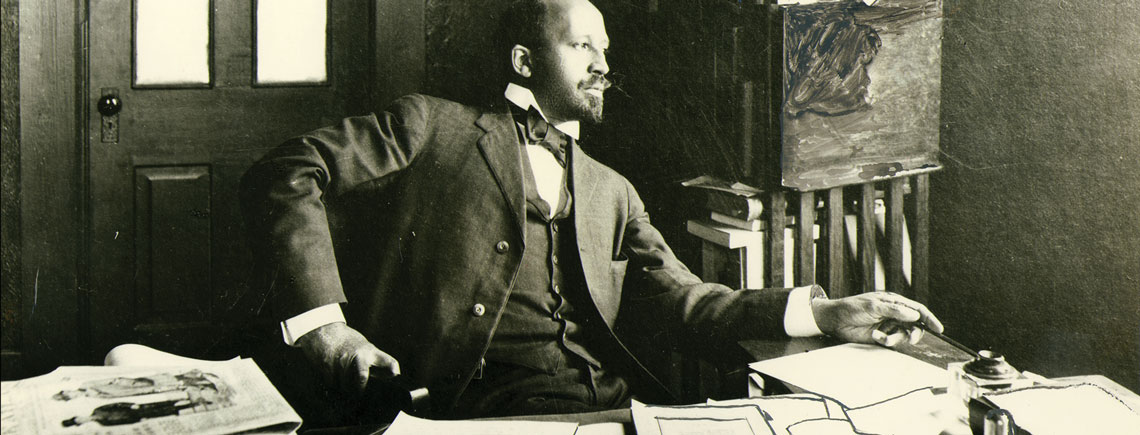
Farther north, Great Barrington has commemorated Du Bois in a river walk, by naming its regional middle school after him, making his boyhood home site a National Historic Landmark and commissioning a bronze sculpture of him expected to be completed this year.
At the same time, the Clinton A. M. E. Zion Church, in which he participated as a boy, is being transformed into the W. E. B. Du Bois Center for Freedom and Democracy. The church was the spiritual, cultural and political heart of black life in the region for nearly 130 years and was a formative influence on Du Bois.
Last week the Du Bois Freedom Center announced that former White House senior advisor and New York University professor Ny Whitaker has been selected as its executive director.
Whitaker will lead the transformation of the historic Clinton Church into an African American cultural and heritage center. When complete, it will serve as a visitor center, an interpretive venue, a hub for regional African American heritage sites, a community meeting space and a cultural gathering spot.
“This is an exciting moment of growth for the center,” said board Chairman Chris Himes. “With our new leadership, we are in a strong position as we enter the next phase of this project. We are closing in on our goals: to honor the legacy of Du Bois, the former Clinton Church and the rich role of African American communities in this region and beyond.”
This year the Freedom Center will host Reflections on Democracy, a series of educational programs and public events that analyze Du Bois’ writings on the subject.
Great Barrington was the cradle of Du Bois’ development. Born only three years after the Civil War, a descendent of enslaved forebears, he spent his first years in Housatonic, a village within the borders of Great Barrington. His father disappeared when he was 5 years old and his mother moved to her father’s farm two miles outside of Great Barrington.
His grandfather soon died and his grandmother sold the farm. Things went from bad to worse when Du Bois’ mother suffered a stroke that left her partially paralyzed. Du Bois was 7 years old when they moved to a dingy second-floor apartment on Railroad Street. The neighborhood swarmed with drunks, gamblers, saloons and at least one house of prostitution.
It was an unpropitious beginning but he was fortunate in the community surrounding him. Post-Civil War Great Barrington had an integrated, albeit tiny, minority of freed blacks. Local blacks enjoyed the rights of citizenship even if they were socially segregated. Du Bois recalled that “the color line was manifest and yet not absolutely drawn.” Still, he conceded, “some of the white citizens took (my mother) and me into a sort of overseeing custody.”
The town was magnanimous to the precocious boy. A few months after DuBois was born, the town voted $2,000 to create the town’s first public high school and the town’s public schools became the educational backbone of DuBois’ success. His high school principal, Frank A. Hosmer, a crucial supporter and mentor, was so impressed with the boy’s abilities that he encouraged Du Bois think about college.
Du Bois’s poverty meant he couldn’t afford his textbooks but Hosmer solicited funds from prominent community members. Du Bois later wrote that Hosmer believed in academically preparing promising black youngsters so they could provide leadership to the black masses. “He, therefore, took it on himself to guide my schooling without showing condescension or favoritism,” Du Bois wrote.
As a teen Du Bois was already showing his inclination for social activism. Noticing during a town meeting that no black men were present, he wrote in an article for The Globe, “The colored men of Great Barrington hold the balance of power … If they will only act in concert, they may become a power not to be despised. …”
The “nagging problem of finance,” and the need to take care of his ailing mother delayed entry into college until her death when he was 17. Du Bois wanted to go to Harvard but some of the leading white citizens advised him to go to Tennessee’s Fisk University, a black college founded by the American Missionary Society.
A scholarship plan was developed and Du Bois embraced the idea of going south, where he hoped to find more social outlets and greater professional potential. But Fisk was only a way station on his educational journey. He completed graduate work at the Friedrich Wilhelm University in Berlin and at Harvard where he became the university’s first black Ph.D. recipient.
Du Bois rose to national prominence as a Civil Rights activist. He was one of the founders of the NAACP in 1909 and, after World War I, attended Pan-African Congresses, fighting for independence for African colonies held by European powers.
He was a prolific author, writing more than 20 books and hundreds of essays and pamphlets, covering topics ranging from history and education, to segregation, poor housing and to the subjugation of black women. He penned groundbreaking books such as The Souls of Black Folk, and Black Reconstruction and established sociology as an academic discipline. He edited the NAACP's Crisis magazine for nearly 25 years, consistently speaking out against racism.
Borrowing a phrase from Frederick Douglass, he popularized use of the term “color line” to protest the inequity of the “separate but equal” doctrine prevalent in American social and political life. Late in life Du Bois embraced the concept of communism, asserting that capitalism was a primary cause of racism. Naturally, he was targeted by J. Edgar Hoover’s FBI.
He spent the last years of his life in Ghana and died in Accra in 1963, where he was buried.
Despite his international career, Du Bois retained his affection for Great Barrington he buried his first wife and two children there.
When he was 60 colleagues purchased his grandfather’s house and presented it to him as a birthday present. Du Bois felt a special bond to the property—which had been in his family for more than 200 years—and planned its restoration, a project that never came to fruition. He later sold it and the new owner demolished the building.
Until recently Great Barrington did not return his affection. Attempts in the 1960s to develop his boyhood home site as a memorial were thwarted by opponents who expressed distaste for his socialist leanings. Nevertheless in 1976 the site was declared a National Historic Landscape.
Even today, his legacy appears to rest uneasily with some in Great Barrington, despite the formation of a Du Bois Legacy Committee in 2018. Last October a petition circulated objecting to the creation of benches in front of the Mason Library, one of which will support the seated bronze sculpture of the dapper scholar. The petition was resoundingly defeated in a town meeting vote.