

Bull's Bridge
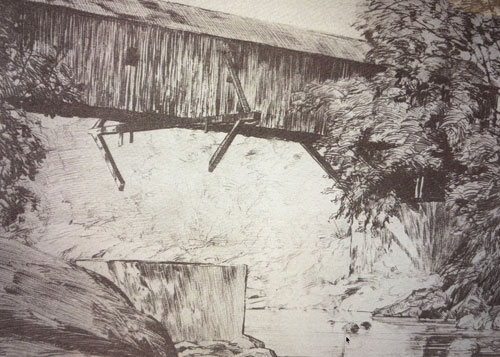
This image of Bull’s Bridge, executed about 1919 by painter and etcher Robert Nesbit (1879-1961), shows the structure before a number of restorations stabilized it. In 1994 Kent native Phil Camp said, “(I)t looks the same today as it did seventy-five years ago. It lists a bit and always has a few broken planks. The interior is unlighted and the traveler must be wary of the never-ending stream of people taking photos.”
The same can be said today but in its earliest form it posed even more significant threats. Reportedly first built about 1760 by Jacob Bull and his son, Isaac, it was used to transport pig iron from Bull's foundry to Poughkeepsie NY. A subsequent bridge was built about 1773 by William Samuel Johnson to connect his iron works with the farm of his brother-in-law Able Beach, who died in during the Revolution.
According to a family legend, the road across the farm became an important highway once New York City was occupied by the British, so the Continental Army officers began to stop at “Madam Beach’s,” as her barns gave "good shelter to the men," and officers were "sure of entertainment in the farm house.” The widow is said to have hosted General Washington on several visits, and he was said to have a high regard for the patriotic widow.
Washington passed through the area several times and there is a long-standing legend that his horse fell through the planking of the bridge and had to be taken out of the river. An entry in his expense account lends credence to the story although there is no direct evidence that it was his horse.
The present bridge dates from 1842. Tolls of 6 cents for a horse and carriage and 3 cents for foot passengers were charged to pass over it.