It's All in The Process
Long ago Don Bracken decided he didn’t want to just paint pretty pictures. He now hopes that his show at the Cornwall Library will resonate with viewers and that they will understand his concern about what is happening to the Earth and its peoples.
Don Bracken is a process-oriented artist whose work evolves through the use of natural materials that are incorporated into his artwork. His materials range from dirt and clay, to ash from California fires and even debris from the 9/11 catastrophe.
“I paint pictures that express my concern about the world we’re in,” he said. “A lot of stuff I’ve done has to do with my reaction to 9/11. And in the last few years it’s been my reaction to global warming and the lack of understanding about it from our government.
“I’ve even used burnt wood in my paintings from the fires in California. That had big impact on me,” said the California native whose sister lives near the decimated town of Paradise.
Indeed, Bracken often has a personal connection to the materials he incorporates into his paintings. He once occupied a 10,000-square-foot studio during an artist’s residency in the World Trade Center where he worked to capture the ever-changing skyline of New York City. “That changed a lot of stuff for me, my perception of the landscape and how I was looking at the Earth and politics,” he said.
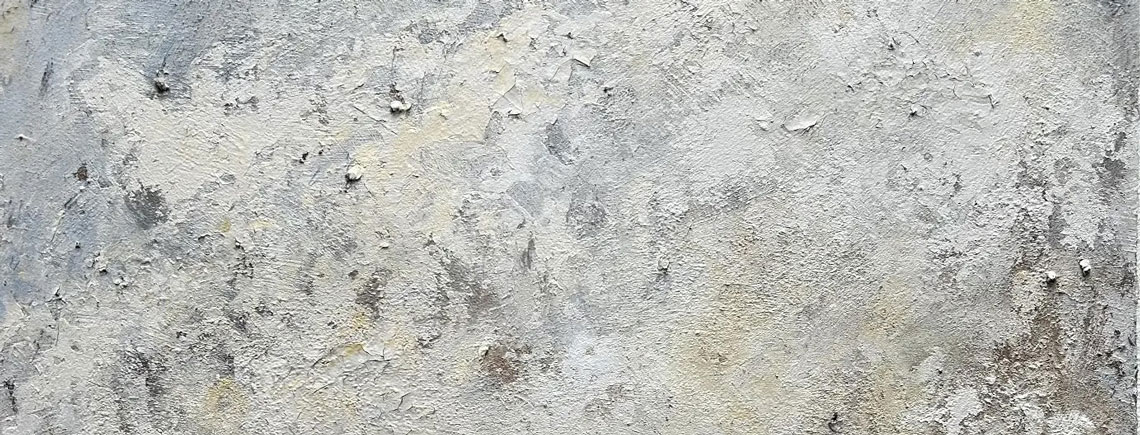
“After 9/11, a lot of my work had to do with shattered reality,” he continued. “I had started painting with dirt and clay and realized its qualities—how it cracks on a canvas. So, I started doing panels with clay, like the World Trade Center, panoramas of Manhattan, all kind of shattered looking.”
The decline of the climate and its effect on the environment have also featured large in his works. He crafted one big sculpture from material sourced from an old beaver dam for a piece he considers his homage to creatures whose habitats are destroyed by humans. The beaver had been trapped and killed and the lodge was ruinous.
His movement from strictly representational work began decades ago. A process-oriented artist is one who prioritizes spontaneity, experimentation, technique and materials over the final, finished artwork. Appropriately, Bracken’s move toward this kind of painting was completely spontaneous.
“I was painting a landscape in Wethersfield along the Connecticut River in 2007,” he reported. “Suddenly, I thought, ‘I’m painting another lousy landscape of a farm.’ I felt disconnected from what I was doing, and like … who needs another idealized landscape? I was so frustrated, I picked up the painting and threw it in the dirt. When I picked it up there was all this dirt stuck to the paint and I thought, ‘That’s cool.’ It set me off on a new trajectory of painting our disappearing farms using their own dirt.”
As his relationship with unconventional materials evolved, he started using limestone, sand, vines and other natural materials to create textural, three-dimensional, landscape paintings. He said the soil of the Connecticut River Valley is so fine he can lay down a medium on his canvas, “dump dirt on it and just mush it around.”
“I can have a base color of, say, yellow, then paint over the whole thing with blue. Then I take a palette knife and scrape away to create a reductive painting—it’s kind of like wood cuts.”
He said that Cornwall potter Todd Piker first introduced him to clay which has become a prominent medium in his works. He works with his own clay-polymer formula that becomes like a thick paint that he applies with a palette knife. “When I first worked with it, I thought it was cool how it cracked as it dries,” he said.
Rather than remaining static on the canvas, the mixtures shrink, crack and elevate as they dry with nature taking a role as a collaborator in the final paintings.
Art can be ephemeral and the experimental artist can find that his works crack or fade. For instance, the notoriously experimental Leonardo da Vinci painted his The Last Supper using unconventional techniques that began to deteriorate within a quarter century of its creation. It has cost millions of dollars and euros to try to preserve even the “ghost” of his original vibrate masterpiece.
But such degradation does not appear likely for Bracken’s works. “Dirt painting is like stucco,” he said. “It’s not going anywhere. People ask, ‘How long will it last?’ and I say, ‘How old is dirt?’”
Bracken was raised in San Francisco and attended Berkeley during the foment of the Vietnam war where he admits to being “somewhat rebellious” amidst that “hot bed of patriotism.” He developed a social consciousness that has not abated with the years.
He moved East more than four decades ago when a Berkeley friend invited him and his young family for a vacation on Lake Wononscopomuc in Lakeville. “It blew my mind,” he reported. “California has big reservoirs and speed boats and it’s too cold to swim in Lake Taos. She brought us out here in July and it was so magical swimming in Wononscopomuc, like a Midsummer’s Night Dream watching all the fireflies on a summer’s evening. I love Connecticut and never really wanted to go back.”
And he didn’t—at least not for long. He has made his home in Cornwall since 1980, working for a while in different trades such as faux painting, carpentry and plaster, reserving his fine art for figurative studies of his children. “We went to the beach a lot and people knew me for doing beach pictures,” he recalled.
He worked in different media—oils, watercolors and acrylics—before moving on to his more innovative materials such as the ash paintings, clay paintings and dirt paintings displayed on his webiste www.donaldbracken.com.
He loves observing the evolution of process-oriented works. “I have always loved watercolor because you can put a little water on the paper with the paint—you can kind of control it but you really have a dialogue with the medium. As a process painter, you allow it to happen. There are a lot of painters who like to discover what different media can do.”
The Cornwall show will be on view at the library, 30 Pine Street, from Saturday, March 7th through Saturday, April 25th. There will be an opening reception March 7th from 4 to 6 PM.