In a Pickle
Just over 55 years ago, a new sport—pickleball—was created on Bainbridge Island in Washington state. After a long incubation, the sport has become the fastest growing sport in the country, totaling 4.2 million players in the U.S. in 2020, a 21.3 percent growth rate since 2019 according to the U.S. Pickleball Association.
Ironically, 60 percent of core players are just as old as the sport—55 years or older.
Its growth has been just as dramatic in the Berkshires where more than 400 Berkshire County residents have become fans. Nick Warren, fitness manager at Berkshire South Regional Community Center, said dozens of people take part in the program at the center with many attending clinics and taking lessons from certified pickleball instructor Tony Richards.
Warren said he regularly gets phone calls asking about pickleball and how the program works. “I believe this sport continues to grow because of the varying nature of play. People that are very competitive and ‘sporty’ can play at a high level and really try to beat their opponents. On the other hand, people can also play for fun and light exercise which really makes the sport accessible to any range of skill, ability, and athleticism,” he said.
The average age for core players is 47 (most are 55 and older) and about 34 for casual players.
As far as gender goes, Warren hasn’t noticed any large variations one way or the other. “I believe there is a very healthy mix of men and women that really enjoy the sport, at least at our facility.”
Susan Ferlauto said her regular pickleball group ranges in age from 45 to 65. “The accessibility of the sport for any range of athleticism really makes it inclusive to pretty much anyone with an interest,” she said.
Ferlauto says she is new to the sport having picked it up a little over a year ago and she encourages others to join in fun. “A couple of weeks ago, at yoga, someone overheard me talking about pickleball and three people in this relatively small class wanted to know where they could learn to play,” she reported.
The Berkshire Mountain pickleball group in Pittsfield has almost 200 members. “They are very well organized,” said Ferlauto. “We also have a group in Great Barrington, and Lenox just installed dedicated courts.”
Ferlauto enjoys the exercise the sport offers as well as the camaraderie it creates. “I have met lots of like-minded pickleball players. The sound and feel of the ball making contact with the paddle, the challenge of learning something new and striving to improve, it all makes the sport fun . . .”
Linda Barbadoro, who picked up a paddle this year, made this observation, “Pickleball is now where snowboarders where when they first started appearing on the slopes and there was a bit of resentment from the skiers. Now it’s a mix and all get along. The same can be said for tennis and pickleball. This is a game that keeps you moving and is fun for all ages.”
Pickleball-only courts are still difficult to come by because of the newness of the game to a mass market. “Pickleball courts are hard to find,” explained Barbadoro, “so you see tennis courts being transformed into pickleball courts.”
But one of the attributes of pickleball is that it doesn’t take as much space as tennis and play is centered around a small area. Thus the sport translates well to indoor spaces such as a gymnasium.
Barbadoro enjoys the sport because it is “physically challenging, requires some concentration and focus, is strategic, takes technique so there’s lots of room to get ‘better’ at it, it’s unpredictable and just plain fun.”
She added, “It's social; I personally like playing doubles and, generally, the people who are playing are pretty nice.”
Pickleball was reportedly created during the summer of 1965 when a Bainbridge Island, Washington family was bored and wanted to set up a badminton net. They could not find the ball (called a shuttlecock), so they improvised by lowering the net and grabbing a wiffleball. Pickles, the family dog, happily chased after errant shots and then hid in the bushes. Thus was born “Pickle’s ball,” later shortened to pickleball.
A pickleball court is 20-feet-by-44-feet for both singles and doubles. The net is hung at 36 inches at the ends and 34 inches in the middle. A non-volley zone, commonly called “the kitchen,” extends seven feet back from the net on each side. The game is played with a perforated plastic ball and composite or wooden paddles about twice the size of ping-pong paddles. It can be played indoors or outdoors.
The four basic rules of pickleball are that the ball must stay in bounds; there should be one bounce on each side of the net; serving must be done at the baseline and the serve can’t land in the no-volley zone. The game ends at 11, 15, or 21 points. There are other minor rules, including one dictating that the ball can’t bounce twice.
The sport is relatively inexpensive, requiring a paddle smaller than a tennis racquet but larger than a table-tennis paddle and made from several materials. The paddle’s core material affects the feel and energy transfer into the pickleball.
Generally in a honeycomb shape, the most common core type is polymer, while other core types are nomex and aluminum. Polymer is the most common and provides a “plusher” feel than nomex cores. It is versatile for driving power and touch shots. Polymer cores, offering all-around playability, are quieter than aluminum and nomex cores.
Nomex is a firmer core that provides the most power and ball speed but at the cost of control. It is also audibly louder than polymer cores These cores are effective for skilled singles players or beginners looking for effortless power but be careful in noise-restricted neighborhoods.
Aluminum cores are lightweight and easy to swing but have low levels of power. They are not as loud as nomex but still much louder than polymer. Being lightweight, this paddle is easy to for juniors or players who have difficulty swinging a standard paddle to use.
Pickleball paddle surfaces are the visible areas that makes contact with the ball. The paddle surface affects feel, power, touch and spin. Common paddle surfaces include fiberglass (composite), graphite and carbon fiber.
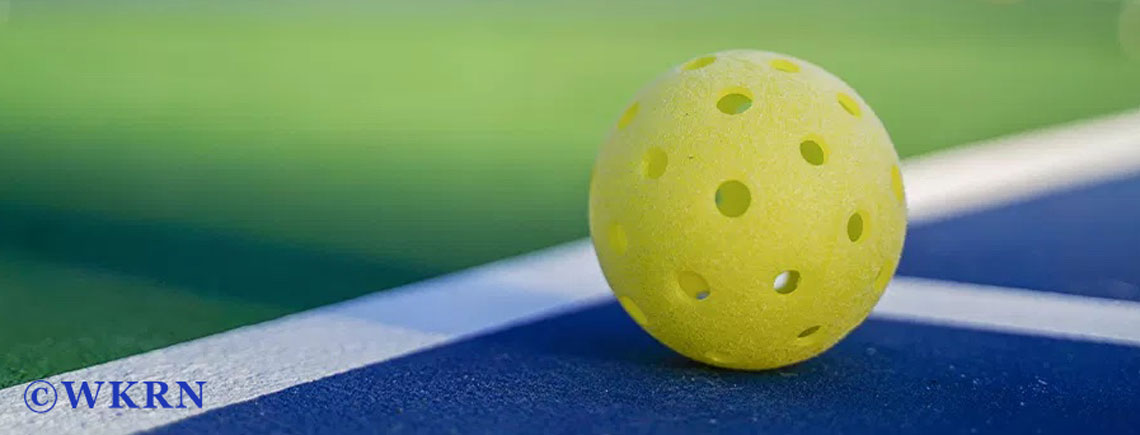
The ball used for play is similar to Whiffle balls, lightweight with holes. And, as for apparel, t-shirts, shorts, polos and sweatpants are standard options. Comfortable tennis shoes are a must.
For information on where to play, please visit the website listed below.