John Robshaw
New Store in Falls Village
For the Puritans of 17th Century Massachusetts, black was too stylish, reserved only for esteemed elders. The general population was clothed in colors of russet and feuille morte (dead leaf). Imagine how this dour lot would react today if they wandered into John Robshaw’s new Falls Village shop, replete with its riot of patterns, stripes, prints, textures and colors.
For the renowned textile designer, for whom color is a celebration, too much is never enough. He describes himself as a “pattern and color junkie” and says he cannot stand the constraint of an “all-white room.”
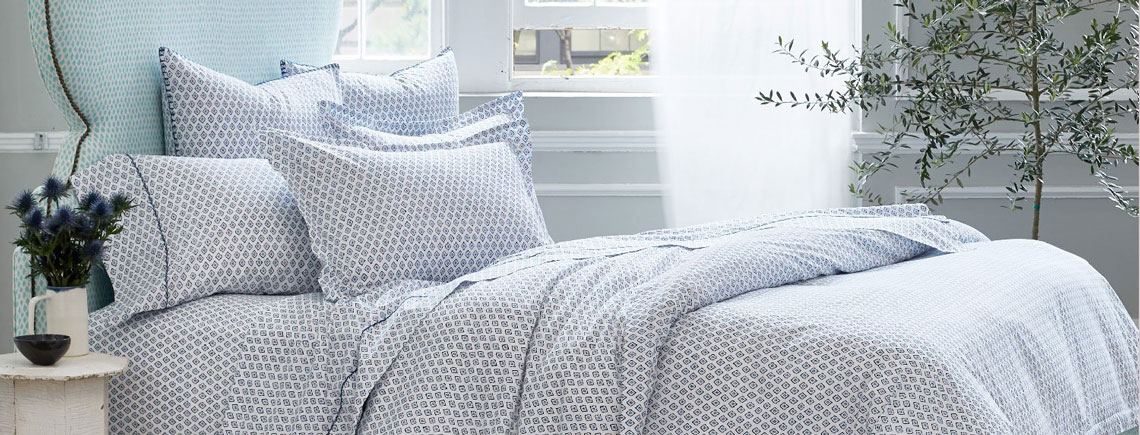
So, his new textile shop reflects this obsession, offering a wide variety of pillows, quilts, sheets and blankets as well as textiles for the bath, furniture, artwork and even pajamas—all carrying with them the aura of Asia. Robshaw’s furniture—consisting of daybeds, chairs, ottomans, room screens and more—can be customized with any of his vibrant fabrics, making each a reflection of the customer’s personality.
In bringing his textile line to his new outlet, located at the intersection of routes 7 and 126, Robshaw adds his cachet to a coterie of well-known designers who have claimed the Northwest Corner as their home. In tiny Falls Village, noted interior designer Bunny Williams has long made her home, carefully tending to and expanding her own estate while establishing a stylish boutique at 100 Main Street to market the works of local artisans.
In Sharon, Cora Ginsburg, LLC, an antique costume and textile dealer, has set up shop while nearby, in Amenia, interior designer Darren Henault, founder of Tent New York, is fulfilling his ambition to fill rooms with “light, texture, quality, form and mood.”
Robshaw, of course, knew of these pioneers who had established fashion outposts away from the bustle of New York City. A weekend homeowner in Sharon for more than a decade, he had contemplated making the move himself. Then, the time arrived.
He learned that West Cornwall-based antiques dealer and garden designer Michael Trapp had put his Falls Village farmhouse up for sale and jumped at the opportunity. His new shop, with its studio on the second floor, opened in the waning days of 2021. A barn on the property is now used by Robshaw’s wife, photographer Rachel Robshaw, for photo shoots.
The globe-trotting Robshaw had his wings trimmed by Covid but still manages to produce two new product lines every year, turning out 75 to 100 new prints every six months. His firm creates its designs in the United States—he still retains a studio in New York—and sends the artwork to India, Thailand and the Philippines where local artisans carve block print designs and use traditional methods to design fabrics.
Indeed, it was on one of his first trip to India, after earning a fine arts degree at Pratt and studying traditional block printing in China, that he fell in love with fabric-making traditions. He attended the National Institute of Design there to discover what was happening with textiles and became enamored with blocks and prints—and the fact that the work was done by hand. Visiting artist families well-known for their work, he learned to make batik fabrics and vegetable-dyed ikats in which yarns are tie-dyed before being woven into fabric.
In the process, he moved away from art that is hung on walls and toward “art that people can sleep under,” finding satisfaction in the “idea of use and function.”
In his 2012 memoir entitled John Robshaw Prints: Textiles, Block Printing, Global Inspiration, and Interiors, he describes the first prickling of this interest. “I stumbled on some cheap bolts of heavy cotton denim in a Williamsburg (Brooklyn) warehouse, and I bought the whole lot,” he related. “This would make for my first big breakthrough in creating art using fabric.”
He tried painting on it but didn’t like the results, describing them as “too heavy and clumsy,” obscuring the inherent beauty of the fabric. Splashing bleach on the fabric, à la Jackson Pollock, began to reveal hidden patterns.
Further experimentation with a studio mate’s sewing machine enabled him to make collage “paintings” out of scraps. “I was adding colors but not hiding how the fabric was made. I loved how there were no secrets, nothing hidden—the colors only added to and enhanced the obvious,” he wrote.
He was, at that time, selling block prints from a group gallery space but began to notice that customers were more interested in the unique fabrics he created and stored there. Ever alert to opportunity, he shifted his focus to running his own bedding and textile business, designing fabrics for Ralph Lauren, Donna Karan and Giorgio Armani before launching his own line.
He has built a thriving furniture and textile business with estimated revenues of more than $10 million a year but has yet to lose his joy in creating and using fabric as his medium for self-expression. “Some trips are documented in films and mine are in textiles,” he said in a video interview. “Traveling alone is a way to learn about who you are and what you are, to kinda dig deeper and find out what is important to you.”
His own home is an endless experiment in the use of fabrics to bring a certain joie de vivre to daily living. “It is fun messing around, … playing with color,” he said. And he added, “the fun part is you can fold them up and put them away when you want a change.”
His shop is located at 5 US-7 in Falls Village and is open Friday and Saturday, 11 AM-5 PM and some Sundays. Email theshop@johnrobshaw.com or call 917-781-0130 for any inquiries or to make an appointment outside of listed hours.