Klocke Estate
Brandy may have been one of the most elegant accidents in history.
Distilled from wine, it was first created some time in the Middle Ages, perhaps as a tax dodge when wine, transported by ship or cart, was assessed by volume. Merchants distilled the wine to lessen its volume and, thus, the tax.
They thought they would add back the water upon delivery but, lo and behold, they found their customers enjoyed the distilled drink ,which took on flavors from its wooden casks, better than the original product. Brandy became the first distilled beverage in European history.
Brandy has come a long way since the days of its first crude distilling, becoming one of the most refined—and often most expensive—drinks. And nowhere has the bar been set higher than at Klocke Estate, a new earth-to-glass brandy and vermouth distillery by day and a fine dining destination by night.
The $21-million venture is the dream of entrepreneur John Frishkopf, a business executive, and his partner in business and life, Brett Mattingly, a financial and operations executive. “I bring entrepreneurial and finance backgrounds and knowledge about wine making. He brings engineering and operational expertise,” Frishkopf explained.
A native of Boston, Frishkopf said he has been fascinated by wine and spirits since he was in college. While studying business in California, he learned to make wine and later mastered the art of making brandy during the decade he lived and worked in Europe.
Frishkopf built a career in diverse industries but his agricultural interests had taken firm root in his youth. “There are a lot of wineries in the region,” he reflected, “but very few brandy distilleries. We decided to create luxury brandy and make our distillery a destination. That was the vision and about 15 years ago I started working on a business plan.”
Eight years ago he decided to make his vision of a vineyard and distillery a reality. He retired from his other careers in 2016 and moved to the Hudson River Valley six years ago. “This is an all-consuming project,” he said. “There is no room for other businesses.”
The first task was to find a location for their new venture. They found a 160-acre farm in Claverack that had lain fallow for some time and began a long, intensive process of reclaiming it by using sustainable regenerative agriculture techniques.
The name, Klocke Estate pays homage to the owners’ ethos—they proclaim on their website, “We believe that making fine brandy is a celebration of time and place.” Klocke is Dutch for ‘Clock,” a nod to the Dutch who first settled the region and the time and patience needed to produce fine spirits.
The estate, now fully operational, has a 12,000-square foot distillery and hospitality venue. After eight years of intensive and scientifically adroit reclamation—in 2020, for instance, they began to use biochar, a charcoal-like substance to enhance nutrient and water retention in soils and boost plant growth—they have 60 acres under cultivation and their first crops in the barrels.
Klocke employs about 50 persons, about 35 of whom work in hospitality with the remainder on the farming and production side. “We hired a master blender from Cognac,” Frishkopf said. “He flies in a few times a year and trains the team.”
Such is their dedication to “best practices” for production, they had their copper still made in Cognac, France. A second still, used to produce “eau de vie,” a clear brandy made from distilled fruits, came from Germany.
“The idea was to use best practices for production in everything from how we grow the fruit, to how we process it, to distilling, maturing and blending,” Frishkopf said. The best stills for brandy are from Cognac. And for an aged fruit product, you want to use a French oak cask. It’s an entirely different species and creates a different flavor profile. American oak ends up overwhelming the fruit.”
The barrel room was constructed using the same concepts as Cognac barrel rooms, its timber frame crafted by a local woodworker. It has clay and lime soil floors and walls made of straw bales coated in plaster to provide maximum breathability.
The partners expect to harvest about 25 tons of 43 varieties of apples this year and aim to get another 100 tons in the next year or two as they bring more acreage into production.
In addition to the apples, their vineyards are flourishing, producing Baco Blanc, Seyval Blanc, Ugni Blanc, Vidal Blanc, Traminette, Riesling clones from Germany and Alsace and Cayuga, all necessary components of quality cognac.
Frishkopf says the world’s changing climate generally favors the products the partners have targeted. “The Hudson River Valley is fantastic for apples,” he reported. “It has a silty clay and loamy soil similar to Calvados in France. We make an apple-style Calvados (brandy). And grapes are not that picky. They grow in many soils. For cognac, the best soil is chalky—which we don’t have—but part of Cognac (the town in southwestern France that is the center for producing the brandy) does have some clay.”
He wants visitors to the estate to learn about the spirits produced there and to experience the terroir of the Hudson River Valley. Terroir refers to the unique combination of natural factors that affect the flavor and character of a crop, such as soil composition, climate and elevation.
“The experience is not just a product,” he said. “It is the way the fruit is grown, the spirits distilled and the brandy enjoyed that come together to create a transportive experience.”
The estate will launch its first aged brandy this weekend. Referent Apple Brandy is described as a “carefully composed blend that reveals remarkable depth and character” and is priced at $275 a bottle. It will be available on November 2nd.
While the apple brandies are reaching maturity, Frishkopf said the grape brandies have been in their barrels for almost three years but still are not ready. “With apple brandies, it depends on how they are matured,” he said. “In the United States, grape brandy has to be aged at least two years but with apples there are no rules.”
In addition to its brandies, Klocke Estate also makes vermouth, a fortified wine. “Vermouth is having its moment,” Frishkopf observed.
For a period in the 20th century, vermouth was widely considered as stodgy, outdated and an unglamorous afterthought in cocktails. This reputation was a significant departure from its origins as a sophisticated aperitif and cocktail ingredient. But the perception of vermouth has changed in the past decade. Today vermouth is shedding its stuffy image as part of a classic cocktail revival and a broader trend toward lower-alcohol beverages.
Consumers and bartenders appreciate the artisanal vermouths available and vermouth is increasingly popular as a lower-alcohol alternative to hard spirits. It is now commonly served chilled, either neat or on the rocks, as a sophisticated pre-dinner drink.
“We make a beautiful vermouth meant for sipping and not for cocktails,” Frishkopf said. “In Spain, it’s all the rage to go to vermouth bars.”
He said the estate will launch another, richer vermouth next month that will be more suited for cocktails.
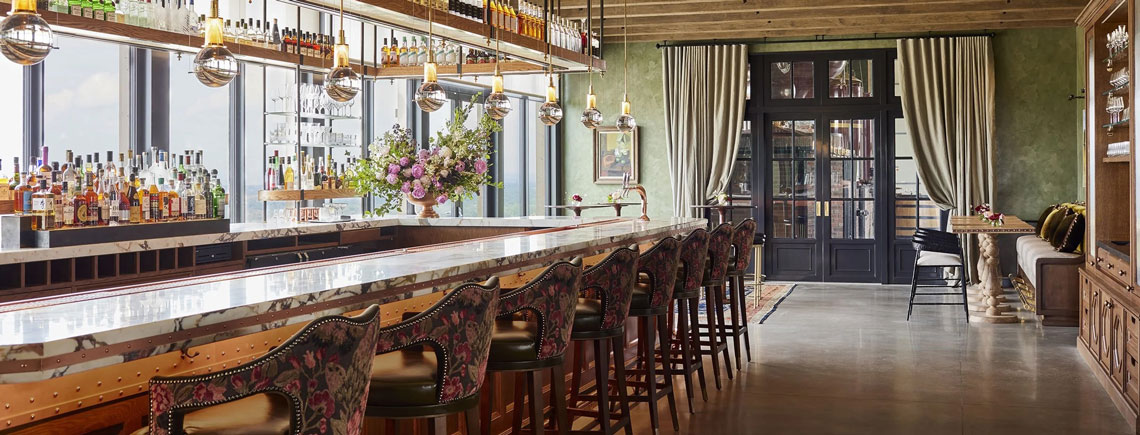
The beauty of the Hudson River Valley is amply on display when visiting the estate and a tour and tasting is perhaps only a prelude to a satisfying meal in the onsite restaurant. “The space is extraordinary,” said Frishkopf. “It was designed by a famous designer (Ken Faulk, an Architectural Digest “100” designer) who did a beautiful job. It defies any category. We wanted something timeless, something that creates a counterpoint between luxury and rustic, something that speaks to European heritage and the Hudson Valley.”
The restaurant building has several zones, each with its own purpose. Guests can do a tasting on the north side, have cocktails and snacks at the bar with its panoramic view of the Catskills or sit in the dining room for a gourmet meal.
Executive chef Becky Kempter designed a menu that leans toward traditional French cuisine and that pairs well not only with wine but also brandy and vermouth in keeping with the overall vision of Klocke Estate.
Brandy and vermouth find their way into both savory and sweet dishes. Kempter has reported that guests particularly favor roasted duck with red vermouth and the most popular dessert pairing has been a local apple tart with aged Calvados.
The bar serves up Klocke’s own spirits but also offers an extensive wine program and a selection of local craft brews.
The estate sells its products through its own venue but also has about 70 other accounts in New York State. “As a craft distillery, we can sell direct and online,” Frishkopf said. It is hoped that business can be expanded into Connecticut and Massachusetts next year.
Frishkopf said the estate’s products have been received “extremely well” by the cognoscente. “I think in a blind taste test, experts couldn’t tell the difference between our cognac and Europe’s,” he said. “And our eau de vie is even more extraordinarily ranked.”
Tours and tastings are offered Wednesday through Sunday, noon to 9PM; autumn restaurant hours are Wednesday through Sunday, 5 to 9PM. Reservations are available on Resy and walk-ins are welcome.
After Thanksgiving, winter tour hours will be Friday through Sunday, noon to 8PM; restaurant, Wednesday through Sunday, noon to 9PM.
The Klocke Estate is located at 2554 County Route 27 in Hudson, NY; 518-672-1166 or klocke-estate.com.