The Sixth Extinction
Among the many environmental crises that face the world is a homegrown one—the use of decorative invasive plants in private and municipal landscapes. While frequently beautiful, these hardy little thugs elbow out native plants, spreading across the landscape to the detriment of eco-diversity.
And in changing the balance of the eco-system their presence ripples out to affect many other aspects of life, changing the habitat that feeds and shelters native wildlife and rippling up the food chain.
“We are at the beginning of the sixth mass extinction,” asserts Christian Allyn of Canaan, owner of Invasive Plant Solutions. “The extreme loss of native species has all been caused by irresponsible human activity. We are responsible for the death of the native landscape and it is our responsibility to restore it.”
As the planet shrinks through commercial activity, the plant invasion has occurred in all nations, changing ecosystems around the world and resulting in the extinction of many species of flora and fauna. “We have 84 invasive plants in Connecticut, some more difficult to defeat than others,” observed Allyn.
Among the thorniest—quiet literally—is Japanese Barberry, which is choking forestlands, forcing out native plants and changing the food web for countless creatures. It even threatens human health by harboring mice under its prickly dome, helping the spread of Lyme Disease-infected ticks.
In a 2019 study of the effect of Japanese Barberry on the North American environment, Robert E. Clark, PhD., of Washington State University and his co-author, Chad L. Seewagen, PhD, of the Great Hollow Nature Preserve & Ecological Research Center in New Fairfield CT, noted that in areas around barberry concentrations, food webs experience a “trophic downgrading,” reconfiguring populations of plants and animals in and on the soil by modifying its acidity and nutrient cycling. This disruption can change insect and invertebrate numbers, rippling out to unsettle the food sources for migratory songbirds and native herbivores through the loss of plant life. Predator populations are affected by the lack of herbivores.
Japanese Barberry even affects human health, providing a protective habitat for tick-bearing mice. One study found 166 ticks per acre were infected with Lyme Disease in untreated barberry infestations compared with 50 infected ticks per acre where barberry was controlled and only 20 infected ticks per acre in adjacent forests where there was no barberry. “Field mice hide under the barberry’s dome and ticks have a happy home,” said Allyn.
The pretty-but- perilous plant was introduced to the United States in 1875 as an ornamental and was eventually promoted as a substitute for the common barberry, an exotic plant brought to American by early European settlers for hedgerows, dyes and jams.
“Barberry comes in many forms and many different cultivars, varying heights and colors,” said Allyn. “Most of the cultivars on the market are fertile and capable of spreading.”
For those who like the sturdy, deer-resistant and colorful barberry bushes, there is a guilt-free alternative however. UConn horticulture professor Mark Brand devoted 15 years to creating a seedless, and therefore sterile, version. He hopes that eventually the supply of the sterile shrubs will grow to meet consumer demand, pushing invasive varieties out of stores.
“There is a one-in-100 chance that the flowers will produce a seed, so the sterile barberry bushes don’t solve the problem but it is a big step forward,” Allyn said.
Another shrub beloved by homeowners for its bright red fall cover is the burning bush. “It was installed in yards between the 1970s and ’90s,” Allyn said. “It has also become an extreme hedgerow and understory pest because it blocks out light and allows other invasives to propagate, rendering forestland usable.”
Tom Zetterstrom, another Canaan resident who has spent decades fighting environmental degradation, said the invasive problem is the “unintended consequence” of introducing decorative plants into an alien landscape. “Bittersweet was introduced with good intentions,” he said, noting one prominent family planted it to create a grouse habitat. “Now we have a mass of bittersweet crawling up the mountain. These invasive plants are often attractive because they are red. We can make wreaths out of bittersweet vines, but after Christmas we throw it out in the back yard and there are those seeds … . Everyone was doing something for a good reason.”
Good reasons or no, the consequences are real and Allyn and Zetterstrom dedicate a good portion of their time to eradicating invasives along roadways and rivers. Zetterstrom explains that birds often eat the berries and seeds from the invasive plants and then “carpet bomb” areas around hedgerows and forest edges.
“Edges on road sides and river fronts usually have diversification because of their openness to light and because of the birds using those corridors,” Zetterstrom explained. “Because of the aggressive nature of invasives, the same transmission methodologies result in their exponential proliferation. We get concentrations of them along hedgerows and edges.”
Humans help to transmit other seeds. Roadwork is a prominent factor in moving seeds from one place to another, according to Zetterstrom. He said Japanese Knotwood is easily spread because its tuber-like roots break up.
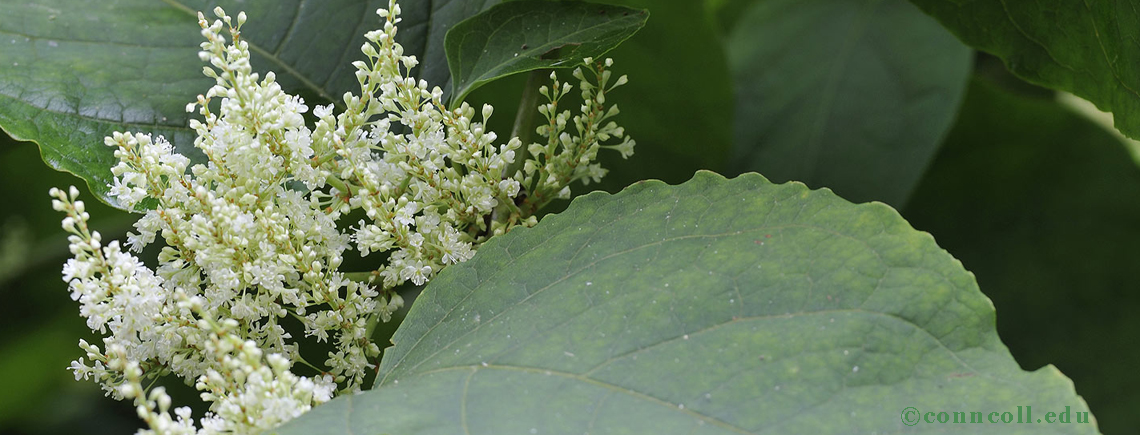
“It’s a vegetative perennial that was brought from Japan in the 1850s,” he related. “It has a glorious display of white blossoms in August and that was the attraction. And because it grows so rapidly, it supposedly controlled erosion. But they didn’t understand that the flooding cycle was a mechanism for breaking the roots apart and therefore we facilitated its unique biology and explosive expansion.”
Indeed, in trying to control erosion in the Housatonic River watershed, it was planted along the riverside. “When it grows alongside a river and the bank erodes, the water takes root segments downstream. It gets along roadsides and then, when there is construction of drainage systems, they excavate it in the dirt and take it to town garages for use later as fill. That is the number-one vector for knotweed. In Cornwall we realized 27 spots of knotweed came from the town gravel pit.”
The damage done by knotweed is again its effect in the food web. “It doesn’t support the insect life that the fish eat,” Zetterstrom said. “There are so many ripple effects in the food web—it expands almost beyond our comprehension.”
Alien insect species have destroyed some of our native trees, such as the American Elm and the ash trees. Ironically, one of the most common invasive trees was brought in as a replacement for these lost trees. Norway maple became the go-to tree because it is sturdy and attractive. So popular did it become, it is now the most common shade tree in North America, according to Allyn.
What is the problem? It changes soil chemistry to favor itself. Allyn explains that North American plants are dependent on mycorrhizal fungi, specialized fungi that colonize plant roots in a symbiotic manner and extend far into the soil. Mycorrhizal fungal filaments in the soil are truly extensions of root systems and are more effective in nutrient and water absorption than the roots themselves. European and Asian plants are not dependent on the fungi and can out-compete the North American varieties, he said.
Allyn said eradication of invasives can often be done mechanically in yards and on town lands but that herbicides are necessary in the wild. “The first thing is to get rid of them properly,” he said. “The best way in a landscape setting is to mechanically remove them or chemically treat them with the least impact. In a wild setting, chemicals and herbicides can’t be avoided.”
He offered some suggestions for homeowners who want color and texture in their yards without resorting to invasives. To replace Japanese barberry, he suggests bayberry with its pale blue, waxy berries, inkberry holly or winterberry holly which has bright red berries that hold through the winter. Burning bush can be replaced with red twig dogwood, which will produce “a nice red foliage in the fall.”
Black Tupelo, which produces “bright, fire engine red leaves” in the fall, is a good substitute for the Norway maple as is the sugar maple. As a caveat, he says sugar maples must be planted uphill and at least 50 feet from roadways because they are extremely salt intolerant.
Other urban forest tree suggestions include white and red oaks, the red maple, crabapples, plum and cherry trees and the European beech (no, it is not invasive).
“We must take care to eliminate invasives,” Allyn said. “It has been done before. In the 1900s there was a federally funded program to remove common barberry. We need that type of initiative.