In Varietalse
Voluptas
Wine warms the soul in so many ways. It is beautiful to behold when held against the light, cradled in sparkling crystal glass. It can be bold or delicate on the tongue, equally delightful when partaken in the mellow sunlight of a summer afternoon or by a crackling fireside on a cold winter night.
It is a primeval pleasure, passed down to us over the millennia by our forebears but, while wine was a favorite beverage for early settlers in America (water was often contaminated and milk bore pathogens that killed painfully), it did not flourish as an agricultural crop in Connecticut until the 20th century.
Admittedly there was fledgling production in the first half of the 19th century, with a large vineyard flourishing in Bridgeport in 1827. By 1858 it was said that “the culture of the grape and the manufacture of wine or rather syrup from our native grapes, is beginning to be a source of remunerative employment in Connecticut.” And at the 1876 centennial exhibition in Philadelphia W.N. Barrett of West Haven and C.E.B. Hatch of Cornwall both displayed grapes in Connecticut’s booth.
But despite the twining vines found on Connecticut’s Great Seal, various factors—climate, the Temperance Movement and Prohibition—all served to suppress wine production in the Nutmeg State. It was not until 1978 that Sherman Haight of Litchfield turned from cattle to chardonnay, importing European vinifera grapes and producing wines on his Haight Vineyard property. He was joined in his pioneering effort by Dr Paul DiGrazia, who established DiGrazia Vineyards in Brookfield, and Bill Hopkins, who created Hopkins Vineyard a year later in Warren.
The nascent industry lobbied the Connecticut State Legislature to allow grape growers to produce wine on farms. With the signing of the Farm Wine Act by Governor Ella T. Grasso in 1978, Connecticut farmers began to bottle their first commercial wines, attracting droves of visitors to Litchfield County to enjoy their properties and products.
In 1988, the entrepreneurs established the Connecticut Wine Trail, a state-approved winery and vineyard awareness program that extends from Litchfield County to Long Island Sound. The vineyards on the wine trail grow a diverse assortment of grapes, including Chardonnay, Merlot, Riesling and Cabernet Franc.
These early pioneers established their dynasties but today only Hopkins Vineyard continues. DiGrazia died in 2019 and his vineyard was sold off. Just weeks ago it was announced that the current owners of Haight-Brown Vineyard would close its doors. Justin Pascoe and Mariah Smith had purchased the vineyard in 2021 from former owners Amy and Courtney Brown who bought it from founder Sherman P. Haight Jr. in 2007. On August 1st they posted on Facebook, "Dear Haight-Brown friends and family, it is with heavy hearts that we have decided to close our doors." They did not say what prompted the move.
But the legacy of the original triumvirate of winemakers continues on the northern shore of Lake Waramaug where Hopkins Vineyard continues its tradition of making fine wines on land first settled by Elijah Hopkins in 1787. Over the centuries the farm has raised sheep, racehorses, grain crops, tobacco and, in the more recent past, served as a dairy farm.
In 1979 the first vines were planted, and the 19th century barn was converted into a state-of-the-art winery. Now the oldest continuously operated vineyard under single ownership, it is also the only vineyard in Connecticut with a micro-climate influenced by an inland lake. This allows an extended growing season and grape varieties not normally viable in the northeastern climate. Classic grape varieties are grown on 30 acres adjacent to the winery.
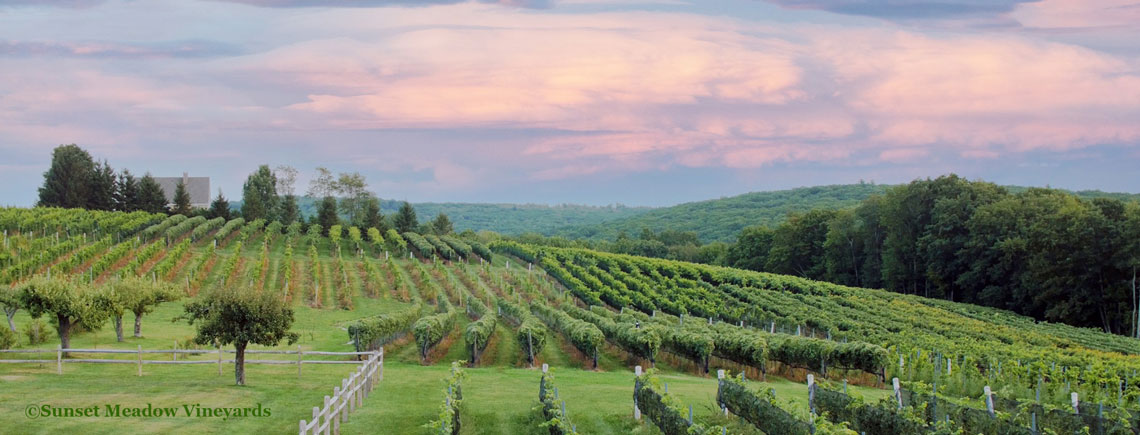
Shortly after the first wineries were established, other growers moved to the area. A long-time favorite is Sunset Meadow Vineyards in Goshen where visitors bring their picnic baskets and blankets to take in spectacular sunsets while enjoying local wines and cheeses.
It was those same sunset views that attracted UC Davis certified viticulturist and oenologist George Motel 27 years ago. By 2003 the Motels had converted the property from producing cattle and hay to Sunset Meadow Vineyards. More than a quarter of a century later Sunset Meadow Vineyards, which earned the distinction of being named New England’s Best Family Winery by Yankee Magazine, is among New England’s largest producing vineyards.
So successful had their endeavor proved, they have since opened a second location in Sheffield MA.
About three years after the birth of Sunset Meadow Vineyards, Stephanie and Tim Ingrassia founded Spring Hill Vineyards on a historic farm dating from the 18th century in Washington Depot. Located along the banks of the Shepaug River in New Preston, the location also enjoys a micro-climate with its weather being moderated by the river. Southwestern facing slopes with rocky, well-drained soils provide a distinctive terroir for their vines which they began planting in 2006.
The couple splits their time between Brooklyn and Washington, CT—she is serial producer of creative construction and design projects and serves on the board of such institutions as Creative Time and the Brooklyn Museum. He is Global Co-Chair of Mergers and Acquisitions at Goldman Sachs and a Trustee of the Brooklyn Public Library and The Cooper Union. Together they created a modest vineyard that has since become home to the Spring Hills Arts Gathering (SHAG), an annual gathering of singers, songwriters, Broadway actors, authors and more.
Their wines and verdant grounds earn exuberant reviews from visitors. “Overall, this was one of the coolest wineries I've ever been to, and it's definitely an awesome experience!” exclaimed one visitor. Another described the winery as a “hidden gem,” while a third enthused over the “large silo with a spiral staircase … where there's a little hangout area at the very top” looking out over “an awesome view!”
Sipping wines and delighting in glorious surroundings can satiate the senses but some people want more. They want to experience winemaking, a process that has engaged humankind for at least 7,500 years. That desire can be satisfied at Shelter Rock Winery in Danbury where Giovanni Petretta guides visitors step-by-step through handcrafting wine.
Petretta’s family has made wine in Santo Stefano del Sole, Italy, since the 15th century. Their connection to the land runs deep but everything changed for Petretta after a devastating 1980 earthquake.
He emigrated to the US and for years the family craft of old-world winemaking lay dormant as he acclimated to a new culture. But the call of his homeland was strong, and he started making wine in the basement of his Brookfield home, purchasing the right grapes and using the old methods shaped by his family. Soon he was invitng friends to help with the process, a group that expanded year by year eventually morphing into Santo Stefano Winemaking, a club based in Danbury.
In 2012 Petretta opened Shelter Rock Winery to introduce winemaking to the public. Shelter Rock Winery is designed to allow visitors to enjoy the consumption and enjoyment of wine and food among the stainless steel tanks and oak barrels. Tasting flights are offered to sample during tours, wines classes, tasting dinners and private parties.
There are many more wineries in Northwest Connecticut that are open to the public. For information, visit The Connecticut Wine Trail.